Categories & Scoring
Understand the 15 analysis categories, scoring methodology, and grading system.
15 Categories
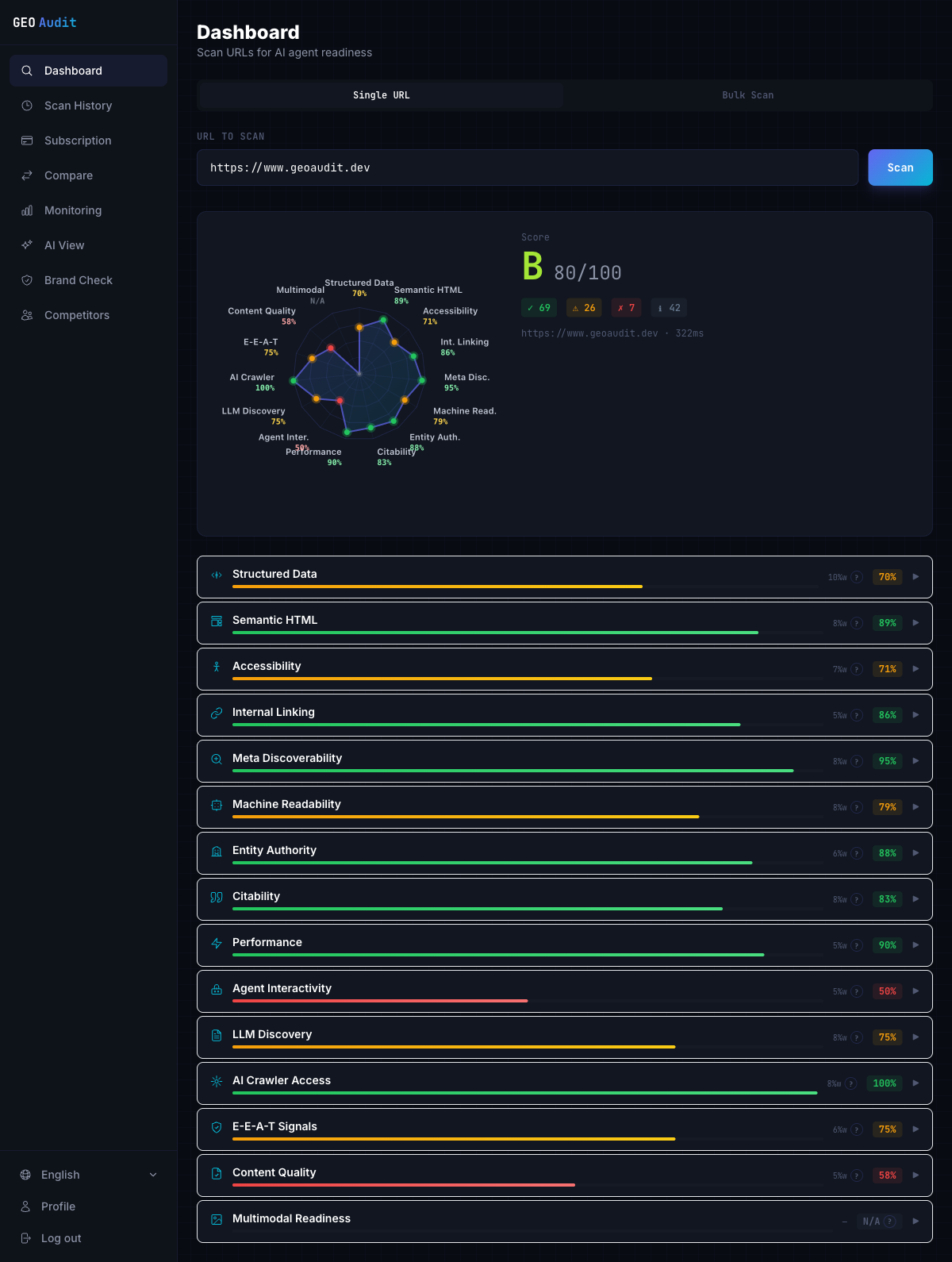
GEOAudit analyzes pages across 15 categories: Structured Data (10%), Semantic HTML (8%), Accessibility (7%), Internal Linking (5%), Meta Discoverability (8%), Machine Readability (8%), Entity Authority (6%), Citability (8%), Performance (5%), Agent Interactivity (5%), LLM Discovery (8%), AI Crawler Access (8%), E-E-A-T Signals (6%), Content Quality (5%), and Multimodal Readiness (3%).
Scoring Methodology
Each check within a category results in one of four statuses: PASS (full score for that check), WARN (half score), FAIL (zero score), or INFO (informational, not scored). The category score is the weighted sum of its check scores.
Category Weights
Categories are weighted from 3% to 10% based on their measured impact on AI agent discoverability. Structured Data has the highest weight (10%) because it most directly enables AI understanding. Multimodal Readiness has the lowest (3%) as it is an emerging factor.
Grade System
The overall score maps to a letter grade: A+ (90–100), A (80–89), B (70–79), C (60–69), D (50–59), F (below 50). Grades provide a quick assessment of AI readiness level.
NOTE